Causal gesture primitives
A causal VAE compresses motion into ordered, continuous latent tokens without discrete quantization.
 Puppeteer

Speech · body · scene
Object-Grounded Posture-Aware
Co-Speech Gesture Generation
Natural gestures that listen to speech, respect posture, and understand the physical space around them.
1Pickford AI 2University of Toronto 3Vector Institute
* equal contribution
Project overview
Abstract
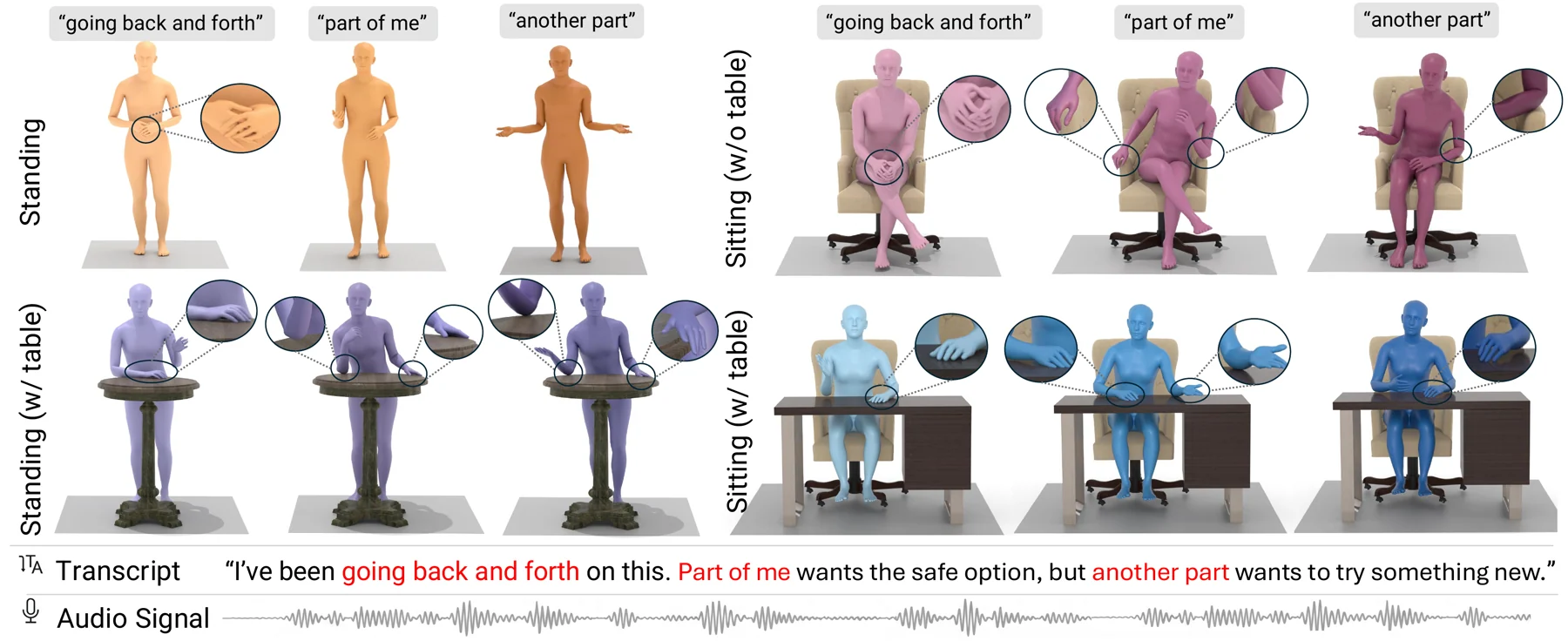
Co-speech gestures should do more than follow a voice. They should remain temporally coherent, carry semantic meaning, and fit the body’s physical context.
Puppeteer is a posture-aware, object-grounded gesture diffusion model that operates in a causal latent space. It decomposes long motions into structured primitives, encodes them as temporally ordered latent tokens, and generates gestures conditioned on audio, text, motion history, posture, and surrounding object geometry.
This design supports precise temporal control, gesture completion and in-betweening, while producing diverse, synchronized motion that naturally responds to nearby furniture and other scene constraints.
Method
Compact causal representations preserve timing; controlled diffusion follows speech and posture; gated fusion grounds the final motion in 3D space.
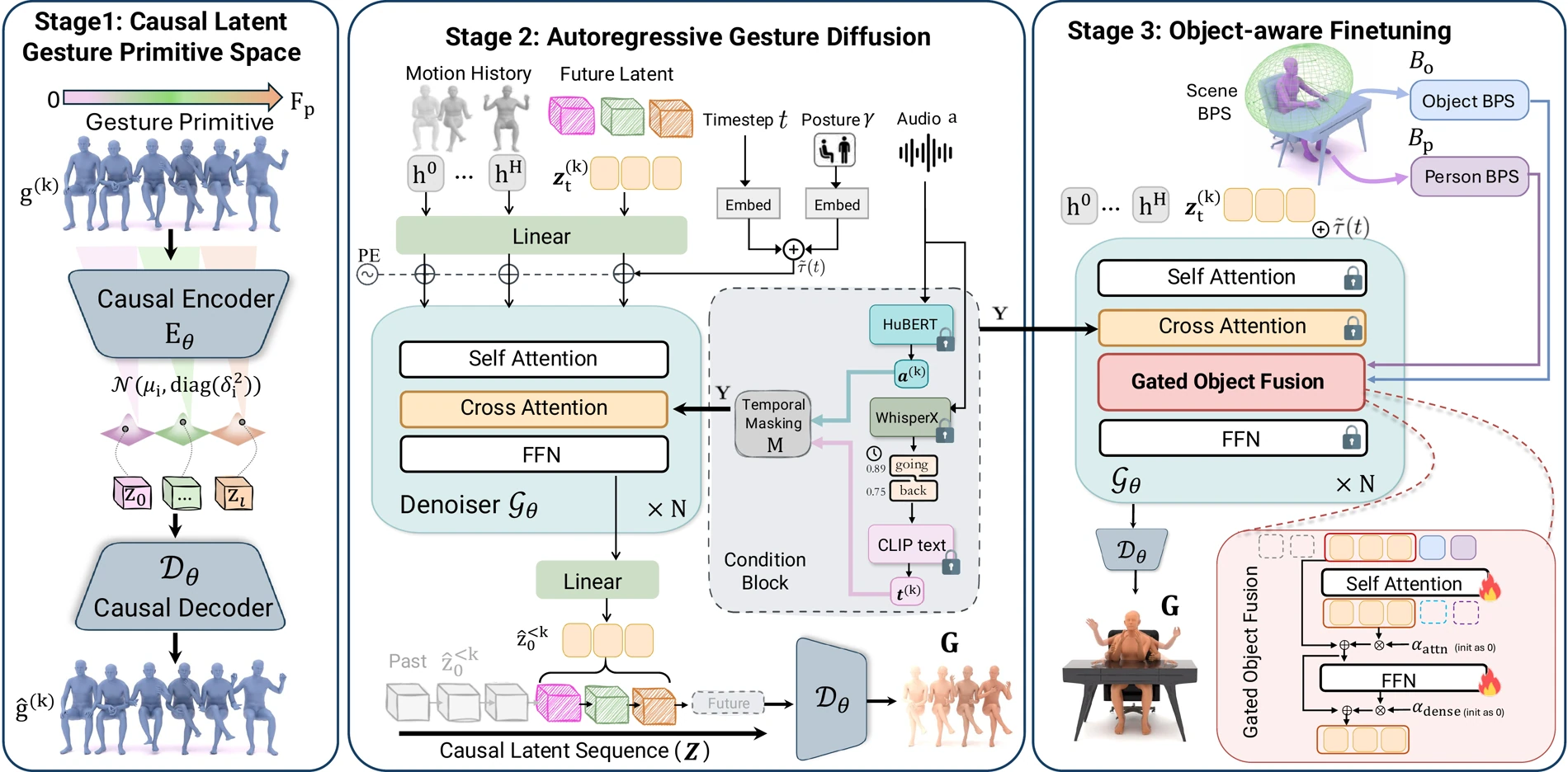
A causal VAE compresses motion into ordered, continuous latent tokens without discrete quantization.
Audio windows and text spans give the denoiser fine-grained rhythmic and semantic control.
Person and object geometry are fused into the model to produce physically grounded gestures.
SceneGes dataset
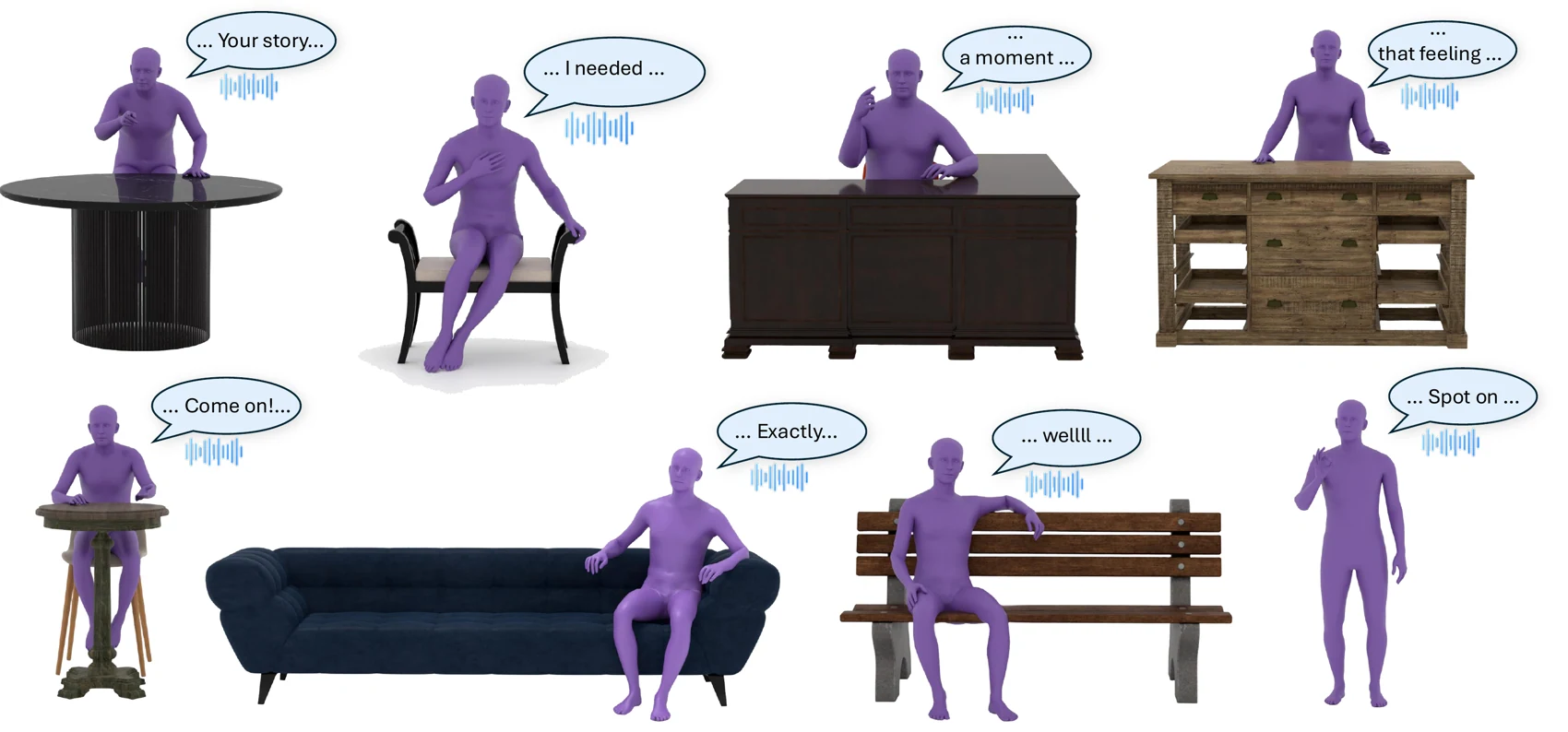
SceneGes is a curated synthetic 3D dataset pairing embodied co-speech gestures with surrounding objects. It enables models to learn how passive geometry—tables, chairs, counters, sofas, and more—shapes communicative motion.
What Puppeteer enables
Windowed audio and word-level text conditioning align motion with rhythm and meaning.
Generated gestures adapt across standing and varied seated configurations.
3D object geometry informs contact, clearance, gesture amplitude, and resting pose.
Puppeteer showcase
A short visual story of speech becoming expressive, posture-aware, and scene-grounded motion.
Try it