Thread and prioritize
A low-latency LLM filters unsafe or off-scene comments, clusters related ones into threads, and ranks them by narrative fit, audience support, and potential for continued play.
 LaughLoop

Chat · Story · Callback
How to Get an Audience to Laugh
at a Live Generative Story
Crowd-sourced humor and shared agency: a live system that turns audience chat into recognizable jokes, callbacks, and story beats about a minute later.
1Pickford AI
NeurIPS 2026 Creative AI Track
See it live
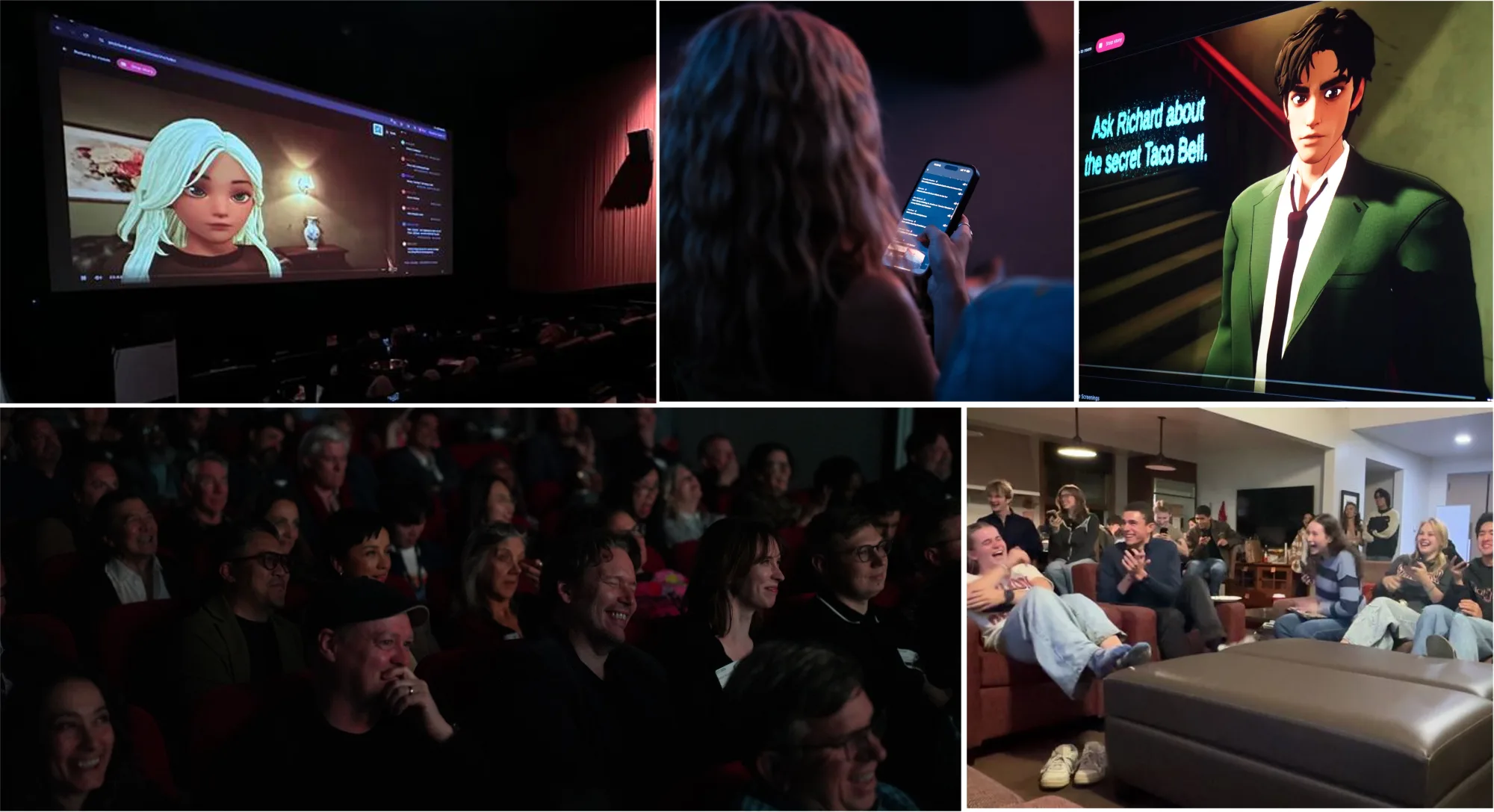
A suggestion typed in the chat can appear on screen in the next story block.
Abstract
Large language models can generate joke-like text, but making a live audience laugh within an audiovisual story requires more than isolated humor generation.
We present a live crowd-to-story system that automatically groups and prioritizes pseudonymous audience comments and integrates selected threads into approximately one-minute audiovisual story blocks. The system clusters related comments, prioritizes them by narrative fit and audience response, preserves recognizable audience phrasing through near-verbatim “whispers,” and stores successful ideas in memory so they can return as recurring jokes and callbacks.
Across 133 stories, 401 participants, and 793 person-in-story observations, early inclusion of a participant’s comment in played story content was associated with a 51.7% adjusted difference in the geometric mean of subsequent commenting. Comment-linked dialogue and on-screen whispers showed positive adjusted differences of 38.1% and 28.1%, respectively. These observational results do not establish causality, but they support the design principle that rapid, recognizable inclusion can reinforce participation. We argue that comic payoff in live generative storytelling emerges through distributed agency among the audience, AI writers, platform, and human creators.
The crowd-to-story system
Generative delivery takes creator-authored story DNA to the screen; a fast content loop feeds chat back into the next block; a reinforcing social loop turns winning threads into callbacks.
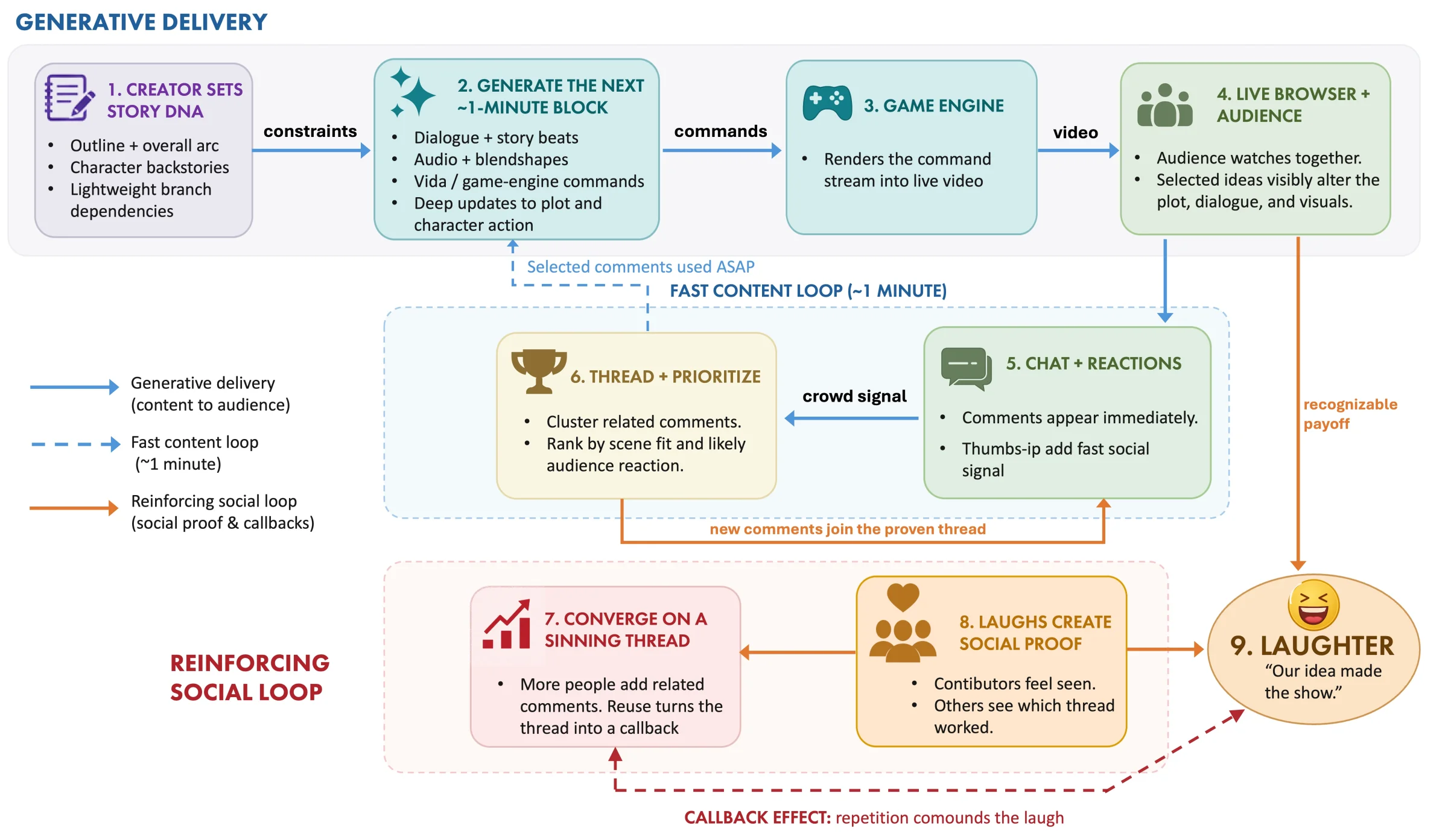
A low-latency LLM filters unsafe or off-scene comments, clusters related ones into threads, and ranks them by narrative fit, audience support, and potential for continued play.
Each ~1-minute block draws on at most two threads plus the story DNA. At least one contribution appears near-verbatim as a whisper; dialogue, voices, facial animation, and game-engine commands render live.
A canonical narrative state and an audience memory track which ideas landed, so a one-off suggestion can become story canon and return as a recurring premise or callback.
Live audience study
Creator Test and Production sessions, May 1 – July 29, 2026. Early inclusion means a participant’s comment appeared in played content between 25% and 50% of story progress; the outcome is that participant’s commenting from 50% to 100%.
Adjusted percent differences in the geometric mean of 1 + second-half comments, with story fixed effects. Observational, not causal. Peer reactions alone crossed zero; recognizable story inclusion is the stronger signal.
Discussion
Seeded jokes and visible successes signal that playful ideas are welcome; recognizable inclusion shows that participating matters.
A recognizable premise gives others something to escalate, contradict, or reframe, so nobody has to invent a joke from nothing.
A joke can start in chat, enter dialogue, shape a character’s beliefs, and return later, proof the world has absorbed it.
Including everything would fragment the story and blur who said what. A few threads, developed well, beat many.
Pure obedience feels mechanical. Reluctance, misunderstanding, and delay keep characters consistent and make the payoff feel earned.
The format gets more reliable around 25–30 people. Bigger crowds add comments overall, but not more per person.
Agency
A comic moment can’t be attributed to a single creator, and the distribution isn’t equal. We call the result crowd-sourced, rather than democratically authored, humor.
Contributes premises, phrases, and unexpected associations; evaluates them through reactions; extends them through replies.
Select and reframe contributions, decide which character carries them, and whether they return later.
Define the story world, characters, arc, safety boundaries, and tone: the space everyone else works in.
Clusters comments, counts reactions, filters threads, manages memory, and sets how fast ideas reach the story.
Citation
@inproceedings{adeli2026laughloop,
  title     = {How to Get an Audience to Laugh at a Live Generative Story:
               Crowd-Sourced Humor and Shared Agency},
  author    = {Adeli, Vida and Schreck, Benjamin and Mehraban, Soroush and Clifford, Cole},
  booktitle = {NeurIPS 2026 Creative AI Track},
  year      = {2026},
  url       = {https://openreview.net/forum?id=iAb96aSsAn}
}
Join the audience